
The future has a usefulness problem
It’s 2036. AI has become extremely good at solving problems. Products are efficient, meetings are optimised, and usefulness is at an all-time high. The only problem is that nobody is surprised anymore.
That’s the world the Sunshine® team walked into when they joined our Playground Day. We introduced ourselves as Quality Managers from the Playground Department, reporting to a very serious Board that nobody ever gets to interact with.
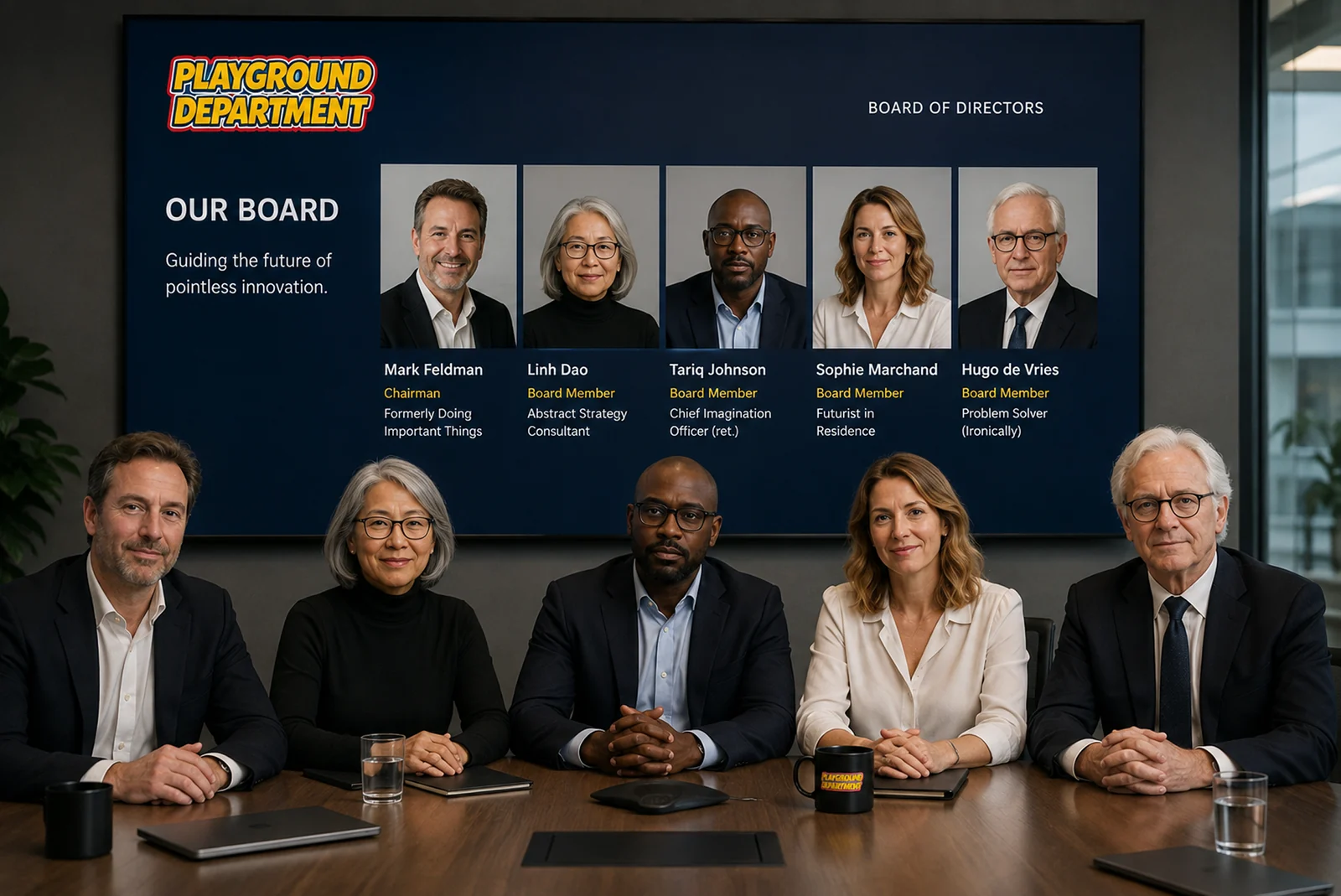
Underneath the costumes and corporate nonsense was a real question. What happens to a team when you take away the pressure to be useful? And what can you see about how people work together when they’re not technically working?
Meet Sunshine®
Sunshine® is an early-stage fintech helping people in Trinidad and Tobago exchange local currency for US dollar stablecoins. The team is fully remote, spread across four time zones, and several members were still relatively new.
This wasn’t a team in crisis. The opportunity was elsewhere: getting to know each other beyond job titles, taking more initiative without waiting to be asked, and building momentum as a team.
Five of six team members described themselves as listeners.
It made us curious about what would happen when nobody was assigned to lead. Would someone naturally step forward? Or would the team find another way of organising itself?
Five hours to build something useless
We started with Two Truths and a Lie, an old game that still does a surprisingly good job of revealing things about people that would never come up in a regular standup.
Then came our signature format, the Useless Challenge. Two random groups had three hours to design, build, and pitch a completely useless product. It didn’t need a business case or a customer, and it didn’t even have to make sense.
The products might have been useless, but the work behind them wasn’t. The teams still had to generate ideas, negotiate disagreements, make decisions, and prepare a pitch together.
Once the teams had found their rhythm, the Board began interfering. Through Trigger Cards, a team might temporarily lose the ability to speak, or suddenly receive an additional instruction.
The interruptions became one of the favourite parts of the day. Operations Manager Adeola Peters described them in her feedback:
Just enough of an interruption to allow for additional questions and bonding.
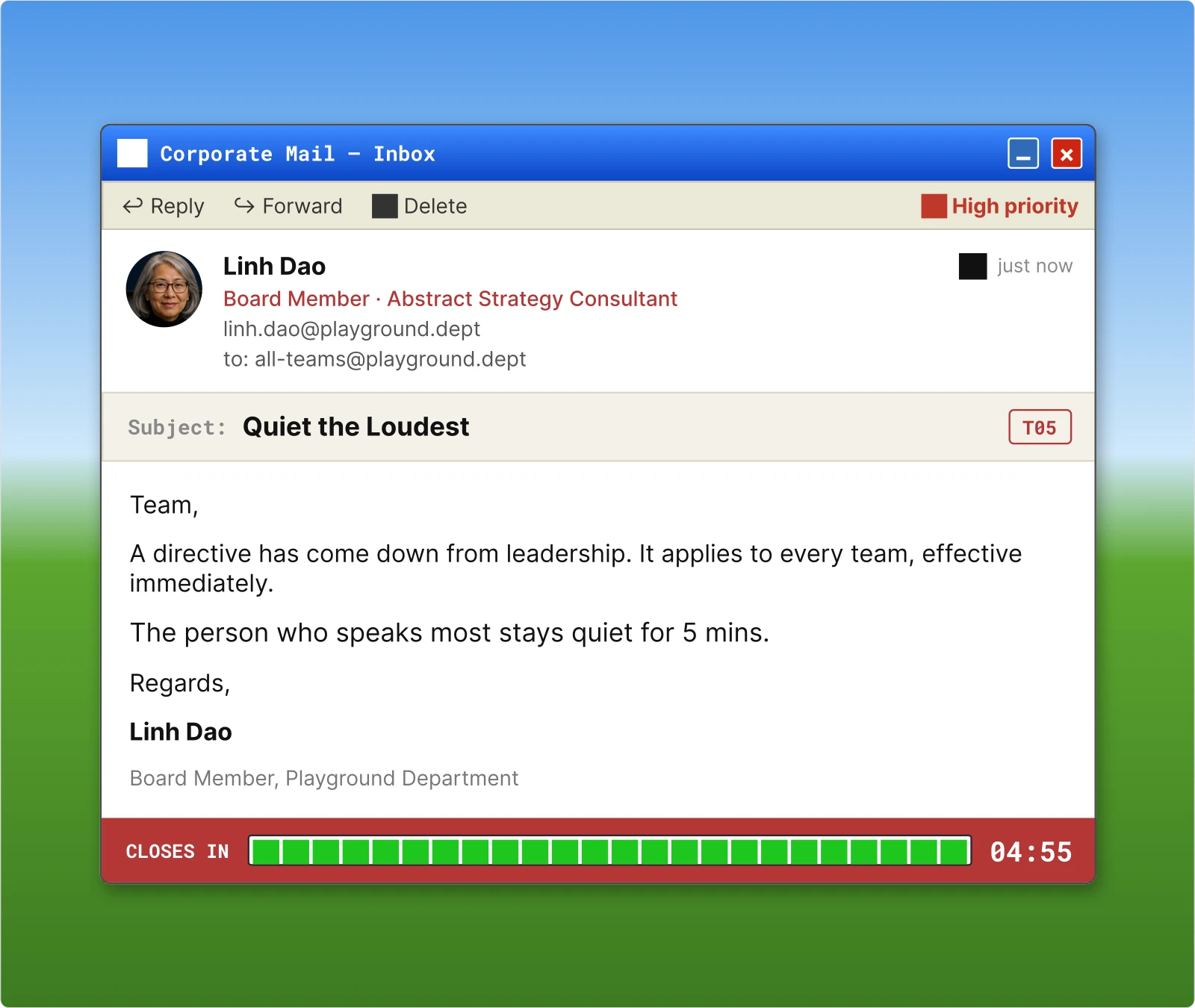
Rather than asking people how they believed they responded to uncertainty, we could introduce a little of it and observe what happened. Who adapted? Who stepped forward? Who created clarity? Every absurd challenge, fictional rule, and unexpected interruption has a purpose.
Two products nobody asked for
Potato Beach was a luxury beach towel made entirely from potatoes, designed for the top 1% of the 1%. Drink Less was a useless alternative to breastmilk that eventually became a picture of a coconut inside a baby bottle.
Both teams pitched with remarkable seriousness. Then it came down to a vote.
For Aaliyah Gonsalves, Sunshine®’s Customer Celebration! Specialist, the challenge had revealed something about the people involved.
It was challenging but showed our strengths.
Aaliyah Gonsalves · Customer Celebration! Specialist
Five hours is a long time to spend on a video call, particularly when you’re building something that serves absolutely no purpose. But when the session came to an end, Jarryon told us the time had flown. One teammate seemed to agree.
It did not feel like 5 hours at all. It feels like it just started.
Participant feedback
The part that isn’t a game
After the pitches, everyone was laughing. For many team-building activities, this would be the natural conclusion. For us, the most important part was still to come.
Each participant received an individual After Action Report and twenty minutes to reflect quietly. Who had surprised them? When had someone taken initiative? When had their team worked at its best? Their answers revealed things we hadn’t picked up on while facilitating.
A founder learns to step back
For Sunshine®’s founder, Jarryon Paul, one of the more interesting discoveries concerned his own role in the team. During the challenge, he noticed how uncomfortable it could feel when he wasn’t the person leading. Yet the team continued working, making decisions, and developing ideas without needing him to direct every step.
Reflecting on the experience during our leadership debrief, he arrived at a wonderfully simple conclusion.
These are all people who do jobs and have brains and could think about stuff, and they do.
Jarryon Paul · Founder
The observation became part of a broader conversation about leadership and ownership. Jarryon began reflecting on how his influence as a founder might affect the way others participated, and whether stepping back more often could create additional room for his teammates to take initiative.
It was a small but meaningful moment. Rather than discussing leadership as an abstract concept, Jarryon had experienced what it felt like to let go of some control and watch his team find its own way forward.
When the team clicked
Looking through the participants’ After Action Reports, we noticed that people repeatedly identified two particular moments when their teams had worked best.
The first was the brainstorming stage, when ideas could be shared without worrying about whether they were sensible, realistic, or useful. Participants seemed to appreciate having permission to think aloud before evaluating what was worth pursuing.
The useless game actually makes the team think out loud whatever stupid ideas they could.
Chiamaka · Product Designer
The second moment came once each group had settled on an idea and everyone understood what they were responsible for. With the direction established and tasks divided, the teams found their momentum.
Together, these observations suggested something useful about how the team collaborated. People valued having room to explore possibilities without immediate judgement, but they also needed clarity about responsibilities once it was time to move forward.
Neither observation is particularly revolutionary on its own. But there is a difference between being told how teams should collaborate and recognising the conditions under which your own team works best.
An unexpected discovery about humor
During our leadership debrief, we asked Jarryon what he knew about his team now that he hadn’t known before. His first answer was something we hadn’t specifically designed the session to explore.
We should probably use humor a lot more than we do.
Jarryon Paul · Founder
Throughout the day, Jarryon had watched teammates connect through jokes and show sides of their personalities that didn’t usually appear in everyday work. Their individual reflections echoed his observation, with several participants highlighting each other’s humor and wit.
For a team distributed across four time zones, those moments offered another way of getting to know the people behind the roles. Someone who might normally be known for their technical expertise, reliability, or ability to deliver on deadlines could suddenly become the person making everyone laugh.
The discovery wasn’t necessarily that the team had developed a new skill. It was that the conditions of the Playground had allowed people to reveal sides of themselves that their normal working environment didn’t always make room for.
Five weeks later, what had changed?
Enthusiasm at the end of a workshop doesn’t tell us much about longer-term impact, so we followed up five weeks later.
Remember the team of listeners? Taking initiative showed the clearest shift of anything we measured. Nobody had been assigned to lead, and by their own ratings, people felt more able to act without waiting to be asked. Knowing colleagues beyond their professional roles was more mixed.
Before, after, and five weeks on
Avg · 1–5 · n = 6Three of the four held or kept climbing. One slipped back. Self-rated by the same six people before the day, right after it, and five weeks later. Average per question on a 1–5 scale. Sunshine®’s founder is excluded, since he answered as the team’s leader rather than as a participant.
Several participants had left the Playground wanting to reach out more, ask for advice, or share responsibilities. Some had begun putting those intentions into practice, but maintaining them proved more difficult.
I started, then it faded.
Follow-up survey
A day of play can create insight, connection, and motivation, but it doesn’t automatically change the habits people return to on Monday morning. Three of the six participants also suggested a different format, and two would have preferred to meet in person.
So, was any of it useful?
For Sunshine®, the Playground created a shared experience, two thoroughly unnecessary inventions, and a different context for seeing one another at work.
For us, it strengthened a hypothesis we’re still exploring: when you lower the stakes around the outcome and change the conditions around the work, different sides of a team have room to show up.
I think it’s a very unique idea and concept and I think it could help a lot of companies. Fun is not so available in the market.
Jarryon Paul · Founder
Maybe it should be.
Nobody needs a potato towel. But a team laughing together, a little surprised by each other, might be worth more than we give it credit for.