


Usefulness comes with baggage
Think about the last time your team worked on something that really mattered. People probably reached for ideas they already trusted and stayed in the roles they already knew. When the stakes are high, playing it safe feels sensible.
Usefulness brings expectations. Expectations bring pressure. Pressure makes us play it safe.
So we take the usefulness away. With no customer to please and nothing that needs solving, people start trying things, and you get to see how a team actually works.
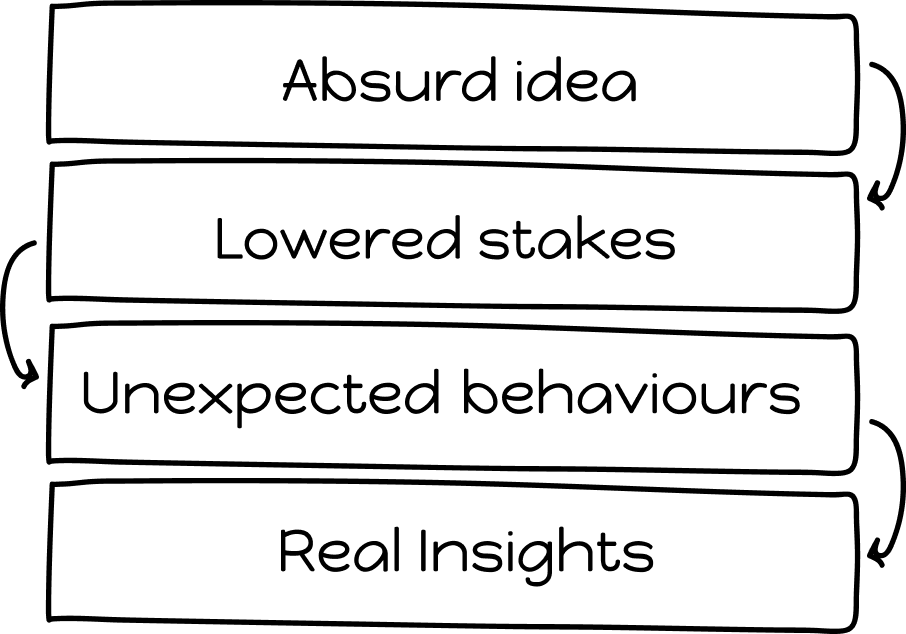
Five design choices behind a Playground Day
A Playground Day borrows from game design and experiential learning. These five ideas shape every one.
A world with different rules
Every Playground Day happens inside a fictional world. For our first client, Sunshine®, it was 2036. AI had become so good at being useful that a team could only prove it was still human by building something useless. Teams answered to a mysterious Board and its Quality Managers.
Game scholars Katie Salen and Eric Zimmerman call this kind of space the magic circle, an idea that goes back to Johan Huizinga. Inside it, job titles count for a little less, and people act in ways they wouldn’t in a normal meeting.
A clear way in and a clear way out
Games use small rituals to mark when play starts and when it ends.
Our way in is a warm-up. Before entering the Playground, the Board “calibrated” each team with a round of Two Truths and a Lie. People learned things about each other that never come up in a standup, and got comfortable with the tools.
Our way out is reflection. The Board steps aside, the story ends, and people look back at the day as themselves.
Permission to be ridiculous
Game researcher Sebastian Deterding calls it an alibi: a good reason that makes it OK for adults to play at all. A serious Board with a serious test is exactly that.
The quiet one pitches. The manager follows. Nobody has to defend it afterwards. You were inventing Tinder for relatives.
A little disruption
Once a team finds its rhythm, we change the conditions with Trigger Cards. A team might lose the ability to speak for a while, or get a new rule halfway through.
We don’t ask people how they handle uncertainty. We add a small dose of it and watch.
Turning play into insight
When the play ends, everyone gets ten quiet minutes with an After Action Report. The questions are about the team: Who surprised you? When did someone take initiative? Only after writing alone does the group talk it through together.
Every day is designed around the team
Before the day, we talk with the leader and send the team a short pre-survey. Both shape the design. Sunshine®’s founder wanted to explore bonding, self-leadership, collaboration and momentum, so some activities were built around those goals and others became things we watched for.
The design keeps moving on the day as well. We pick which Trigger Cards to play, and when, based on what’s happening in the room. A team that’s moving too smoothly might get a little friction.
What a questionnaire can’t show you
Many leaders already use personality or team tools like Myers-Briggs, DiSC, Belbin team roles or Hogan. They show how people describe themselves. A team working together can look quite different.
In our first pilot, five of six team members called themselves listeners. A questionnaire would stop there. In the Playground, we got to see what actually happened when nobody was assigned to lead.
We look at a team from three angles:
The most useful insights tend to sit in the gaps between those three. Someone might worry they push too hard, while their team sees them as the person who holds everyone together.
What one day can and can’t do
A Playground Day won’t fix a team in five hours. It makes patterns visible that usually stay hidden, like who takes initiative and when the team works at its best.
Changing habits takes longer. Five weeks after our first pilot, initiative had risen and held, while other plans had faded. One participant wrote:
I started, then it faded.
Follow-up survey
So we follow up after the day.
- Johan Huizinga, Homo Ludens: A Study of the Play-Element in Culture (1938)Where the idea of the magic circle starts.
- Katie Salen and Eric Zimmerman, Rules of Play: Game Design Fundamentals (2003)The magic circle in game design.
- Sebastian Deterding, “Alibis for Adult Play: A Goffmanian Account of Escaping Embarrassment in Adult Play”, Games and Culture (2018)Why adults need a good reason to play.
- Jonaya Kemper, “Wyrding the Self”, nordiclarp.org (2020)Why reflection after play does the real work.