
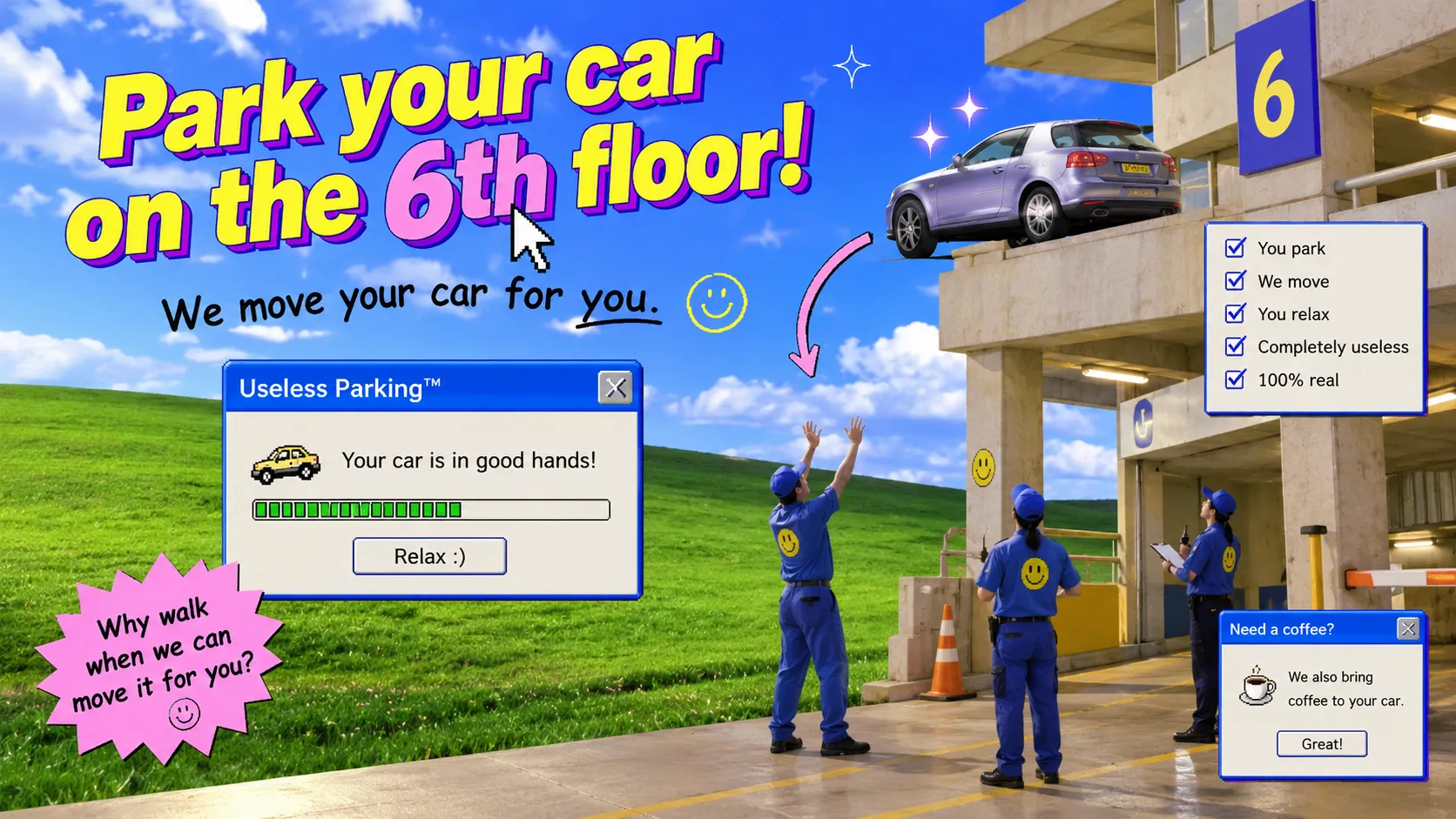
Usefulness comes with expectations.
There are problems to solve, customers to satisfy, and results to deliver. Under that pressure, people tend to rely on familiar ideas and ways of working.
We remove those expectations by giving teams a challenge with no practical purpose. There’s no real customer, no actual problem to solve, and no useful solution to deliver. This gives people room to experiment, try unfamiliar approaches, and interact outside their usual roles.
Being useless is surprisingly difficult.
We’re so accustomed to solving problems, improving things, and finding practical applications that even when we’re explicitly asked to create something useless, our brains keep trying to make it useful.
It’s an interesting challenge in itself, forcing people to question their usual approach to problem-solving.

Want to know more? Read Why Building Something Useless Might Be Good for Business in The Playground Post. →
Five things that make a Playground Day work
A world with different rules
Every Playground Day takes place in a fictional world with its own story, characters, and rules. This creates some distance from everyday work, giving people room to try things they might not normally do in a meeting.
In game design, this temporary separation is known as the magic circle.
A clear beginning and ending
We introduce the fictional world through warm-ups and small rituals that help everyone settle into the experience. When the game ends, we step out of our characters and return to reality.
This gives participants a clear transition from playing to reflecting on what happened.
Permission to be ridiculous
An absurd challenge gives people a reason to experiment with unfamiliar behaviours. Someone who normally listens might take the lead, while someone who usually leads might find themselves following.
In transformative play, this is sometimes called an alibi. After all, nobody needs to justify inventing a beach towel made of potatoes. The Board asked for it.
A little disruption
Our Trigger Cards introduce unexpected requirements, restrictions, and interruptions. A team might suddenly lose the ability to speak or have to change its plans halfway through.
These moments help us observe how people respond to uncertainty, make decisions, and support one another.
Turning play into insight
After the game, participants reflect individually before sharing their experiences with the group. We compare their perspectives with our observations and the team’s survey responses.
People often notice different things about the same situation, and those differences can lead to valuable conversations.
Designed around your team
No two Playground Days are exactly alike. Before the session, we speak with leadership and survey the team to understand what they’d like to explore.
We use that information to design the challenges, choose what to observe, and adapt the experience as it unfolds.
Three perspectives, one team
We bring together three sources of information to understand what happened during the day.
Comparing these perspectives helps us identify patterns and differences worth discussing. Someone might describe themselves as a listener, for example, while their teammates recognise them as the person who keeps the conversation moving.
What happens after the Playground?
A Playground Day creates opportunities for people to notice things about themselves and their teammates. Changing established habits takes more time.
After the session, we share our observations, discuss what the team discovered, and recommend practical ways to build on those insights.
For teams that want to continue, our Playground Cycle introduces small workplace experiments and a return session to reflect on what’s changed.